
#MedComms Freelancing Barometer 2026
From Contentment to Caution:
How Do Freelancers in MedComms Feel About the Road Ahead?
Written by Alex P.P. LoweThis article was originally posted by Alex P.P. Lowe on LinkedIn on 11th March 2026. You can see the original article here.
Freelancing in MedComms has always balanced the promise of autonomy with the uncertainty of what comes next. The 2026 MedComms Freelancing Barometer run by the MedComms Workbook shows that, on the surface, freelancers are more satisfied than ever.
Three‑quarters of the 264 survey respondents described themselves as satisfied or very satisfied with their work. Also, confidence in personal finances and expected income for the coming year has increased since 2023, according to the annual Barometer data
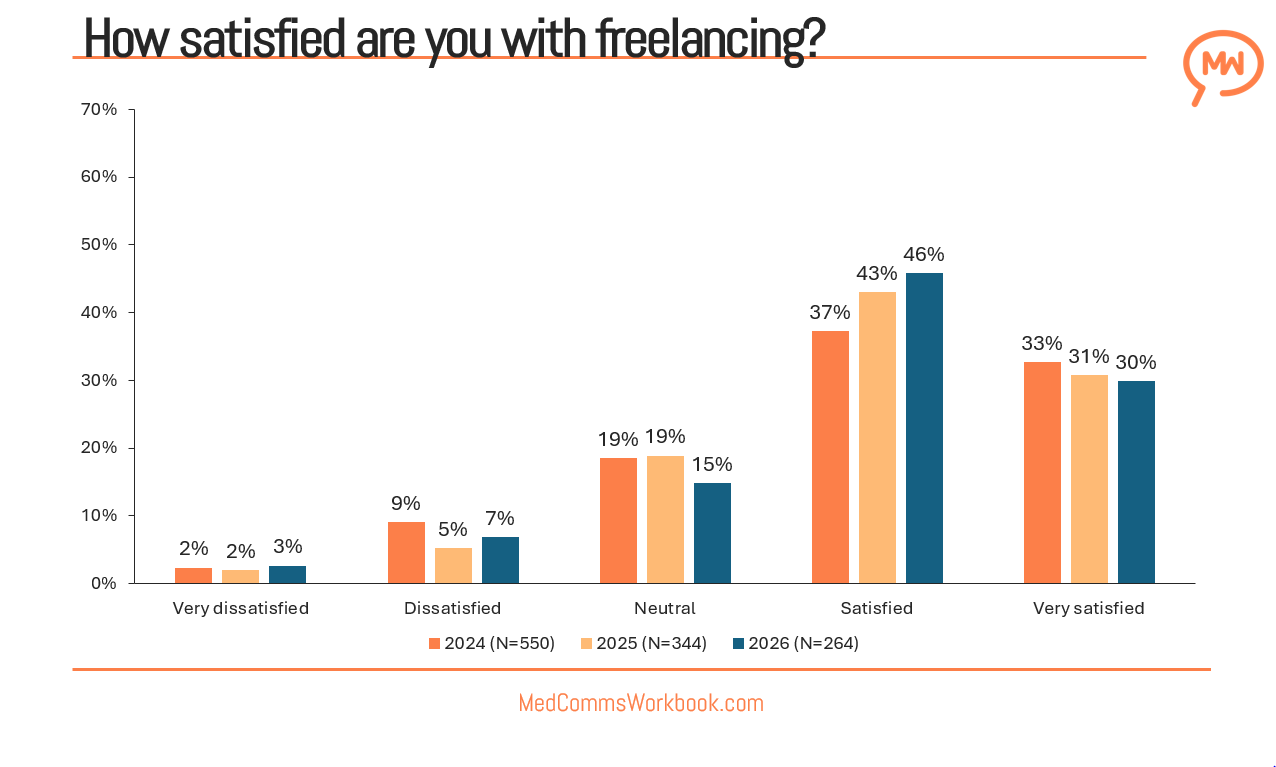
These numbers tell one story, but respondent comments tell another – one shaped by a tension between what freelancers love about their work and what they fear may be changing.
“I love the variety, the independence and the flexibility…”
Many respondents emphasised the freedom to work around family life, set their own hours, avoid corporate pressure, and feel more valued than they did in-house.
“I enjoy freelancing but was disappointed in the amount of work I obtained in 2025.”
This optimism is tempered by perennial concerns about loneliness and isolation, now compounded by growing instability and inconsistent income.
Increasing pressure within the industry is a recurring theme. One respondent noted that they “find the industry harder than it used to be…”, while another observed that “Clients are demanding more work in less time.”
“The things I enjoy about MedComms are being taken over by AI.”
Layoffs, market saturation, and the perceived impact of AI on demand are all contributing to a sense of fragility around future income.
“I may consider stopping freelancing and taking early retirement if incoming work continues to slow down this year.”
Some freelancers are questioning their long‑term future in MedComms. Burnout, boredom, and doubts about the sustainability of freelancing are prompting some to consider full‑time roles or even leaving the field entirely.
Those closer to retirement often express acceptance rather than confidence about income sustainability, acknowledging that their decisions are being shaped by life stage alongside market conditions.
By contrast, younger freelancers expressed more anxiety and a greater likelihood of career pivots driven by financial pressure. As one put it:“If I do not get any further contracts once my current one ends, I may be forced to stop freelancing and look for permanent work.”
“I’m planning to continue alongside a multi‑year training course in an unrelated job area.”
Despite these concerns, a majority of respondents said they were unlikely or very unlikely to stop freelancing, with only 4% indicating they had a current plan to do something different or move in-house. Rather than leaving freelancing behind, some respondents indicated that they are diversifying their work streams - both within adjacent writing roles and other unrelated areas.
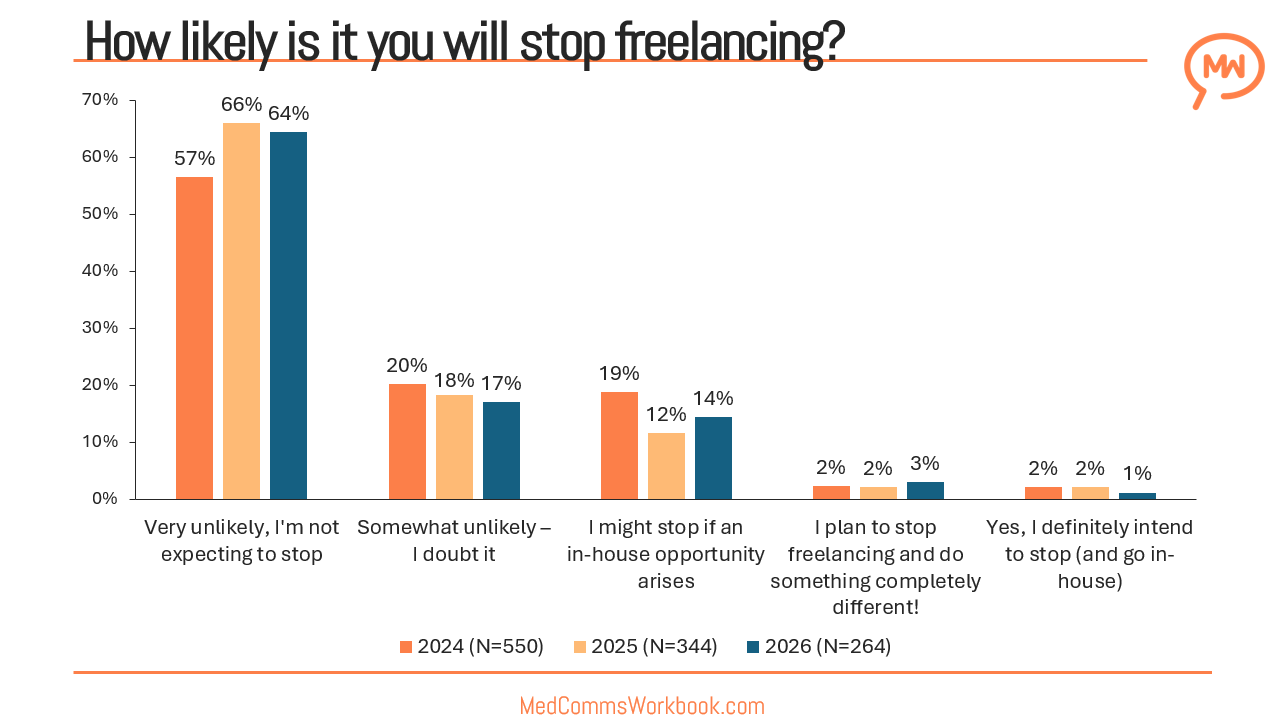
“Freelancing may have its ups and downs but the benefits are too valuable to miss.”
Freelancers in MedComms appear to be navigating a paradox: they are increasingly satisfied with the work they do and unlikely to stop, yet uncertainty remains about what the future holds for freelancers. The 2025 data suggest an industry in transition, one where satisfaction is high, confidence is fragile, and long‑term sustainability will depend on the next stage of industry evolution.